Though vinyl house siding is lightweight, easy to cut,
and can be secured with hammer and nails, there is some craftsmanship required
to install it properly. Thus, do it yourself vinyl house siding should be
limited to the more experienced DIY homeowner.
Installing Home Siding - Wood
There are even more wood based house siding products
to choose from than vinyl. Wood based home sidings include, but are not limited
to Cedar siding, Masonite siding, and log and pine siding.
Installing House
Siding - Aluminum and Cement Board
There are also other house siding materials to
choose from including Aluminum siding and Cement board home siding. Aluminum
siding, however, has waned in popularity over the years, as it dents easily and
is difficult to repair. Also it requires unique craftsmanship skills to be
installed correctly. Cement board home siding, on the other hand, is rapidly
increasing in popularity due to its low maintenance, durability and appearance.
However, it does require more expensive equipment to install, including diamond
tip saw blades and pneumatic nail guns.
In this article we focus on installing Cedar or
Masonite house siding.
Tools Required for Installing Home Siding
·
Table Saw
·
Chop Saw
·
Jig Saw
·
Hammer
·
Chalk Line
·
Carpenters Knife
·
Compass
·
Square
·
Measuring Tape
·
Ladders/Staging
Preparing for Installation of House Siding
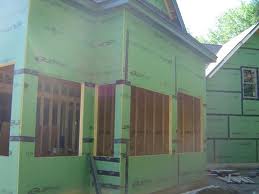
Installing house siding starts with a home that is
trimmed out and has been wrapped in a plastic moisture barrier. The plastic
moisture barrier helps to prevent heat loss while enabling moisture to pass
through. The trim includes all outside soffits, exterior corner and base trim.
Drip flashing should also be installed above all
doors and windows and on top of all base trim. The drip flashing, usually made
out of aluminum in a z like pattern, rests on top of the door/window/base trim
and rises up about 1 inch and is secured to the external house sheathing with
nails.
Establishing chalk lines for the Installation of Home Siding Clapboards
Once the trim, moisture barrier and flashing are
installed, horizontal chalk lines should be snapped every 3.5 to 4.5” inches up
the length of the exterior wall. These lines represent the reveal or width of
the exposed house siding clapboards.
The establishment of the chalk lines should be
started at the base of the house and progress upwards towards the roof. Make
sure that the lines are level; otherwise you will wind up with slanting
clapboards.
The housing siding clapboards should be installed relative to
these snapped lines.
Installing House Siding Clapboards
A small spacer board should first be installed
where the bottom house siding clapboard row will reside. The spacer board is a 1” ripped
length of clapboard. Use the thinner/upper portion of the house siding clapboard for creating
the spacer board. This will help to create a slant that will naturally occur
with the other clapboard layers that lie above it.
Start the installation of the house siding clapboards at the
bottom of the exterior house wall and work your way upwards towards the roof.
The clapboards should be cut to length leaving approximately 1/16th
to 1/8th of an inch (on each side) for expansion.
Note: the bottom house siding clapboard will rest on top of the
drip flashing that curls over the edge of the base trim, and over the spacer
board.
Clapboards should be nailed using galvanized or
stainless steal ring nails. Nails should be installed every 16 inches along the
top and bottom of the entire length of the clapboard, making sure the nails are
secured into wall studs. The nails should be secured into the clapboards about 1
inch from the top and bottom of the clapboard. Done properly, only the bottom
nail will be visible in the finished product.
When you get to the final course of clapboard near
the roof, you will need to rip the clapboard (cut along its length) to the
appropriate width. Note: Be sure to measure and cut such that you remove the top
of the clapboard, otherwise your top clapboard will have an uneven thickness
relative to all of the others pieces installed.
To dress up the top house siding clapboard, install a small
trim board (e.g. ¾ x ¾ inch trim piece) up against the top of the clapboard and
the bottom of the soffit. This will help hide any unevenness that may exist due
to the rip cut or imperfections in the soffit line.
Installing Home Siding around Obstructions
As you install the home siding you will run into
mechanical and electrical obstructions, such as vents, pipes and electrical
boxes and conduits. Sometimes it is best to cut the siding such that the seam is
centered on the obstruction. Other times, it may make more sense to cut out for
an opening on larger lengths of clapboard home siding.
Installing House Siding around Doors and Windows
As with other obstructions, if you need to make
cuts, it is best to create a seam that is centered over the window and door
versus near the edge. It is more pleasing to the eye and will give a more
finished looking product.
If you have arched doors and windows employ the
use of a compass to score a line that matches the curve of the door/window with
the specific house siding clapboard piece. Cut this edge first, and then make sure the curve
of the clapboard cut matches the curve of the door/window. Then cut the other
edge of the clapboard to the appropriate length.
Final Thoughts on Installing House Siding
Installing house siding takes time and it works
best with two people, one for measuring and nailing, and the other for making
the cuts. When installing home siding, you can never measure and check your
lines enough. The worst thing you can do is to install house siding in a
haphazard way. You do not want to wind up with clapboard lines that are crooked.
Again, home siding will make or break your home’s exterior appearance. Take
time to consider what house siding is right for your home and take your time if
you plan on installing it yourself.