|
|
|
Building an Interior Wall
Many Remodeling Projects Require Building an
Interior Wall
By Mark J. Donovan
|
|
From finishing a basement to
remodeling a kitchen the need for building an interior wall often is required.
Building an interior wall is fairly easy to do with some basic tools and a
little bit of upfront carpentry knowledge. When building an interior wall it is
important to tie it in to the existing framing structure of the home, including
the ceiling, floor, and any side walls that the new wall may attach to. Simply
screwing or nailing an interior wall into drywall and/or a subfloor is
structurally insufficient.
|
|
To build an interior wall start by
determining where the existing wall studs, ceiling joists and floor joists are
for the new wall to attach to. To do this you may need to remove drywall from
the existing walls and ceiling, and the finished flooring from the subfloor. In
addition, depending upon whether or not there are existing framing members to
tie the new interior wall into, you may need to add blocking between the
existing wall studs, floor joists and/or ceiling joists to attach the interior
wall to. |
 |
|
|
Normally when building an interior
wall it is constructed out of 2x4s. If you plan to run plumbing drainage pipes
in the wall then 2x6s should be used. Building an interior wall on a flat
surface is preferred, however if there is a lack of floor space to build the
wall you can alternatively stick build it into place.
Once you have confirmed where the existing framing members are, use a pencil to
mark the ceiling and floor joists where the wall will attach to. Use a plumb bob
to make sure the location of the top and bottom plates are perfectly lined up
with each other. |
Next cut two 2x4s to the desired wall
length and then lay them on their flat side on the ground next to each other.
These two 2x4s represent the top and bottom wall plates.
Then use a combination square and pencil to mark the location of the vertical
wall studs on the two 2x4 plates. The wall studs should be spaced on 16 inch
centers.
Next cut the vertical wall stud 2x4s to the desired height
of the wall making sure to account for the width of the top and bottom
plates.
Now, if building the interior wall on the ground turn the top and bottom
plates, as well as the vertical stud members on their edges. Nail the
vertical 2x4 members to the top plate. Then repeat the process on the bottom
plate.
Next raise the interior wall into position by first positioning the
bottom portion of the interior wall followed by the upper portion. |

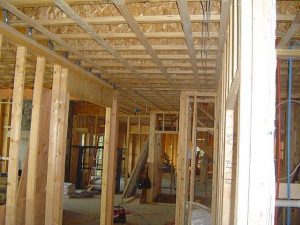
Photo by Mark Donovan |
Use a level to make sure the wall is perfectly plumb and straight before nailing
it into place.
If stick building an interior wall then nail or screw the top and bottom plates
to the ceiling and floor, respectively, where you marked with your pencil. Then
toenail in each vertical stud member to the top and bottom plates, making sure
to position them carefully in the areas that you marked with your pencil and
combination square. As an alternative to toe nailing the vertical stud members
in place you can use stud framing clips.
After framing the interior wall, sheath it in drywall and then mud and tape it
before sanding, priming and painting it.
For a comprehensive new home construction
checklist, see my
New Home Construction Bid Sheet. The New Home Construction Bid
Sheet provides a request for quote checklist section that you can provide to
prospective building contractors. It also includes a comprehensive new home
construction cost breakdown table, in Microsoft Excel format, that allows the
contractor to include his projected new home construction costs for every phase
of the project.
How to Finance your New Home Construction Project -
can help provide funds for your new home improvement project if financing is
required.

Related Articles
Additional Framing Resources from Amazon.com
Free Room Addition
Price Quotes with No Obligation!
Fill out our 3-5 minute quick and easy form, and receive a free price quote
on a room addition from one of our prescreened and licensed home addition
contractors. This process is free and there is no obligation to continue once
you receive your room addition estimate.
|
|
|