Nail the Drip edge around the entire outside perimeter of
the roof.
Apply Ice/Water Shield Membrane & Asphalt
Paper before Shingling a Roof
Apply the ice and water shield material such that it is
flush with the drip edge. If the climate in your area has harsh winters and/or
significant annual rainfall, add a second course of ice and water shield for
added protection. You should also add the ice and water shield membrane in the
valleys.
Next apply the asphalt paper to the entire roof, starting
from the bottom and working towards the ridge. Make sure each course of asphalt
paper overlaps the lower row by several inches (effectively shingling with the
asphalt paper).
Install metal flashing before Shingling a Roof
Install metal flashing in all of the valleys of the roof. Step flashing
around chimneys and dormers will be added as the roofing shingles are installed.
Installing the Roofing Shingles
Start the shingling at the bottom of the roof (or at the
eaves). Lay a starter course of roofing shingles such that the bottom edge of the
roofing shingle lines up
flush with the drip edge. The starter strip is a “tabless” roofing shingle that you make
from the regular roofing shingles using your carpenter’s knife.
Lay your next course of full roofing shingles over the first
course, staggering the starter joints from the first course to prevent water
penetration.
Note: Sometimes you may want to start with a full or a
partial roofing shingle at one end. In either case, you want to try to avoid small
roofing shingle pieces at the far end of the roof. To prevent this, divide the length of
the roof by the length of a full roofing shingle and assess how much of a shingle length
you want to start with. Ideally you do not want to have pieces smaller than 12”.
Use a Chalk Line when Shingling a Roof
To ensure your shingle courses run straight use a chalk
line, such as the
Tajima CR202B-P Chalk-Rite II Ultra-Thin Snap Line with Triple Speed Rewind and 1.4-ounce Bottle Blue Chalk-Rite Chalk
. Measure the finished reveal on your shingles. Usually this is about 5
inches. Then make marks every 5 inches on the gable ends of the roof. Snap a
chalk line between the gable ends at each pair of marks all the way up the roof.
This will ensure that you shingles run true and straight as you progress up the
roof with the courses.
Vertical lines should also be snapped every 3 to 6 feet to
ensure your tabs maintain alignment.
Use of Roof Jacks when Shingling a Roof
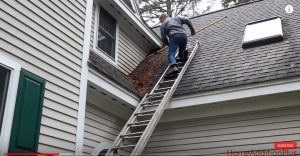
After 3 or 4 courses of roofing shingles have been installed using
ladders, roof jacks, such as the
American Manufacturing Model #3000 10" Adjustable Roofing Bracket
, may be necessary to access the upper courses. Roof jacks
are steel brackets that hold planks in position for you to stand on. The roof
jacks should be securely nailed through the decking and into rafters to ensure
that they will support your weight.
Shingling a Roof - Valleys, Chimneys,
Skylights and Dormers, and Step Flashing
Shingling the valleys and
installing flashing requires extra care. The roofing shingles, typically coming from two
intersecting courses when entering a valley, need to overlap each other such
that no water penetration occurs.
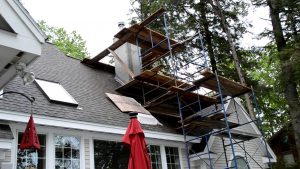
Skylights, chimneys and dormers
must be step flashed (step flashing is interleaved with each course of shingles)
to ensure water is kept from penetrating the roof.
Adding the Ridge Vent and Caps
To complete the shingling of a roofing project,
ridge vents need to be installed. These are nailed to the top of the ridge and
then capped.
The ridge cap prevents water from
entering the home via the ridge vent, while still allowing the house to breath.
The ridge cap is constructed out of individual roofing shingle tabs that have their
unfinished corners cut off at 45 degree angles. Each modified roofing shingle tab, is
nailed such that it overlaps the previous piece as you work your way down the
length of the ridge vent.
Fill out our 3-5 minute quick and easy form, and receive a free price quote
on shingling a roof from one of our prescreened and licensed roofing contractors. This
process is free and there is no obligation to continue once you receive your
roofing price estimate.