|
|
Asphalt roof shingles are the most
common type of roof shingles used on homes today. Asphalt roof shingles come in
two basic styles, 3-tab shingles and architectural shingles. 3-tab asphalt roof
shingles are less expensive than architectural shingles, but typically do not
last as long and are less aesthetically attractive. Asphalt roof shingle
installation should typically be left to the professionals as working on a roof
is dangerous and installing asphalt roofing shingles correctly is imperative for
a leak free roof.
|
|
This said, on a simple 2 plane low
pitched roof, an asphalt roof shingle installation project should be able to be
performed by a handy and brawny diy homeowner.
Prior to asphalt roof shingle installation the roof sheathing should be
inspected for any damage. If there are damaged or rotting roof sheathing pieces
they should be replaced before installing the new asphalt roofing shingles.
Drip edge should then be installed on the roof followed by one or two courses of
Ice and Water shield. The Ice and Water shield should be installed along the
roof eaves, near any adjacent walls to the roof, and in roof valleys.
|
|
Next install roof felt paper over the entire roof surface. Staple the roof paper
down to the roof sheathing.
To ensure a proper asphalt roof shingle installation, use a chalk line to
establish straight and true lines up the length of the roof line. To determine
the frequency of chalk lines measure the exposed reveal on the shingles.
Typically shingle reveal is about 5 inches. Consequently, every 5 inches
establish a chalk line.
Then install metal flashing around chimneys and any wall edges that abut the
roof line.
|
|
With a basic roof consisting simply
of two planes, such as is the case in a ranch or colonial home, asphalt roof
shingle installation begins with applying a row of starter shingles near the
roof eaves. Starter shingles are necessary for preventing water from working its
way through to the roof sheathing between the gaps and notches in the first row
of shingles. You can either use pre-fab’d starter asphalt roof shingles or you
can create your own by simply cutting away the tabs on standard 3-tab shingles.
Position the outside edge of the starter strip shingles ¼ to ¾ inch beyond the
roof eave and drip edge, to prevent fascia board rot.
|
 |
Once the row of starter shingles have
been installed, you can begin the main asphalt roof shingle installation task.
Start installing roof shingles at the lower corner on one side of a roof plane.
For example, start on the far lower left of the roof plane. Install singles in a
stair like pattern working your way to the right and up. Make sure when
installing the shingles that the course just above the lower course are placed
so that the shingle ends and the tab notches do not line up with the lower
course row of shingles. Otherwise you’ll end up with a leaky roof.
| Also, when installing the first row of shingles make sure the edge of them hang
approximately 1/8” over the starter shingle row and roof edge. By doing this you
can prevent water from running off the roof and down the fascia board. Regular
dripping of water on the fascia board can cause it to rot in short order. To deal with the mis-matching of gaps between shingle
courses, trim 6 inches off the course just above the lower course. This will
ensure that the tab notches and shingle edges between the two courses of
shingles do not line up. Repeat trimming as necessary on subsequent rows, in
6 inch increments, as you work your way up the roof line. |

Photo by Mark Donovan |
When nailing down asphalt roof shingles apply the nails approximately ½ inch
below the tar strip. Use 4-6 nails per shingle and make sure to use hot
dipped galvanized roofing nails 1-1/4 to 1-1/2 inches in length.
Cut shingles as necessary around any plastic or rubber flanges associated with
vent pipes.
Near the peak of the roof, the final course of asphalt roof shingles should be
trimmed so that the ridge vent hole is fully exposed.
Plastic roof ridge vent should then be installed over the length of the ridge
vent using long roofing nails.
Finally, nail ridge cap asphalt roof shingles down over the ridge vent. Make
sure the ridge cap shingles overlap each other with the same reveal as the main
asphalt roof shingles. Also, on the first ridge cap shingle tack it down with a
few dabs of roofing tar. |

Photo by Mark Donovan |
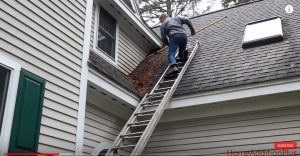
Final Note: Asphalt roof shingle installation is extremely heavy and dangerous
work. Make sure to use sturdy ladders, and roof jacks on higher pitched roofs.
Also, have one or two helpers to aid in hauling shingles up on the roof and
installing the roof shingles. In addition, always wear a good pair of
rubber-soled shoes for solid traction when working on the roof. Finally never
install asphalt roof shingles on a wet or cold roof.
|
Find a Qualified Roofing Contractor in Your Area |
|
Get Free Quotes. Easy, Quick and No
Obligations!
For the home improvement or home remodeling project that is
too big for you, check out our partner
NeedContractor. They are a national
resource for finding pre-screened, insured, and licensed home improvement and remodeling contractors in your local area.
|

|
|
Get Matched in 48 hours with Roofing
Contractors! |
For help on Shingling Your Home's Roof, see HomeAdditionPlus.com’s
Asphalt Shingle Roofing Bid Sheet.
The
Asphalt Shingle Roofing Bid Sheet
will
help to ensure
that
your roof won't end up with a blue tarp over it and a dumpster sitting in your
yard for weeks
as you wait for the roofing contractor to come back and finish roofing your
home.
Related Roofing Articles and
Asphalt Shingle Roofing Cost Estimator
How to Finance your Roof Project -
can help provide funds for your new home improvement project if financing is
required.
|