How to
Fix a Leaky Outdoor Faucet
Simple Instructions for fixing a leaky Sillcock / Outdoor Spigot
By Mark J. Donovan
A frost free leaky outdoor faucet, or spigot, is not just annoying; it can
cost you a small fortune in water bills if left unchecked. In addition, a leaky
outdoor faucet can also cause damage to your home and yard.
Fortunately, for even a novice do-it-yourselfer, a leaky outdoor faucet can
be frequently fixed with just a few basic tools and about 30 minutes of time,
saving you a small bundle in otherwise plumber repair costs.
|
|
Identify Source of Outdoor Faucet Leak
The first thing you need to do is to determine where the outdoor
faucet leak is coming from.
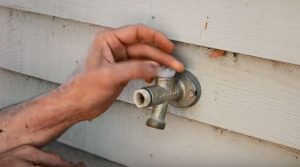
First check to see if the leak is occurring around the top cap that
sits just back behind the handle. Inevitably this cap becomes loose on
frost free outdoor faucets and all you need to do is simply tighten it
back up using your hand. Overtime this cap becomes loose due to changes
in seasonal temperatures or simply from frequent use of the faucet. |
Next, check to see if it is leaking directly out the spout itself.
If the leak is occurring from the faucet spout, even after you have
confirmed the handle is fully turned to the closed position, then chances
are there is a failed washer sitting back behind the faucet handle.
Disassembling the Outdoor Faucet
To replace the washer, first turn the water off to the outdoor faucet.
Usually the shut off valve to the outdoor spigot can be found inside the
home, for example in a utility room just behind the outdoor faucet. The shut
off valve may also be located in the basement.
|
|
Next, turn the outdoor faucet to the full on position to relieve any
pressure in it and to allow the water to fully drain from the faucet.
Now, using a screwdriver remove the screw that holds the handle onto the
faucet.
With the screw removed, pull the handle off.
After removing the faucet handle, use a wrench to remove the faucet nut
that sits back behind the handle. |
Replace Washer and Clean Internal Faucet Area
Typically it is the washer that sits behind the faucet nut (sillcock nut)
that fails. Remove it with your fingers or small screw driver and examine it
for damage or wear. If you see either, replace the washer. Also, make sure
the internal faucet (sillcock) is free from dirt and grime. If there is
grime in it, flush it out with water.
Re-assemble Outdoor Faucet
Once you have replaced the washer and the internal faucet area is free of
any grit, reattach the faucet nut cap, the handle, and the screw that holds
the handle onto the faucet.
|
Find a Qualified Home Plumbing Contractor in Your Area |
|
Get Free Quotes. Easy, Quick and No
Obligations!
For the home improvement or home remodeling project that is
too big for you, check out our partner
NeedContractor. They are a national
resource for finding pre-screened, insured, and licensed home improvement and remodeling contractors in your local area.
|

|
|
Get Matched in 48 hours with Home Plumbing Contractors! |
Test Repaired Outdoor Faucet
Turn the water back on at the valve within the basement or utility room
to the outdoor faucet and observe water flowing freely from the faucet.
Turn the handle to the off position. If the washer or grit was the
problem the leak should no longer be present.
Note that with a frost free outdoor water
faucet, the actual shutoff valve sits far back into the faucet / sillcock
pipe, (approximately 8 inches), so do not be surprised to see a few drips of
water initially after shutting off the faucet. After a few minutes, however,
you should see no more drips. With that your leaky outdoor faucet is a thing
of the past!
Related Articles
Additional Home Plumbing Resources
Outdoor Faucets with Anti-Siphon Valves from Amazon.com
|