| |
A
must have if
hiring a contractor!
|
Finishing Your Basement Walls: At Home with Furring, Shims and
Plumb
By Pamela
Cole Harris
|
|
In the past, many homes were built with unfinished basements and the
homeowner used those dark, bare, usually damp spaces for storage, laundry,
or large collections of spider webs and dust bunnies. You may have bought
one yourself and now, with the high price of new housing, you are looking to
expand your current house to meet your family's needs (do your covenants
really allow 10 story ranch houses?). That unused basement seems be the
answer! |
Want to do it yourself? I suggest you begin by evicting the dust bunnies!
Next, we need to finish the basement walls. Easy, right? Just slap up some
drywall and tape! Wrong. Here's how to do it correctly:
1. Look at the amount of moisture in your basement. Are the
walls moist? Are there mushrooms growing in the corner? Is there standing
water in any part of the area? (If you make the kids wear life jackets when
they go downstairs, you may have a water problem). You should call a
professional for ideas on how to get rid of water seepage. It will be money
well spent and will prevent many problems later.
|
|
2. Estimate the amount of drywall and furring strips (long,
thin wood strips which enable you to attach the drywall to the concrete
face) you will need. For every 4 feet of wall, you will need one sheet of
drywall (we are assuming that your ceiling is less than 8 feet!) and 4
furring strips.
3. Screw the furring strips to the wall leaving a
space of approximately ½ inch from the bottom of the strip to the floor in case
water seeps in. Make sure the strips are plumb (use your handy-dandy level) and
drill holes about 16 inches apart into the wall (use a masonry bit). |
Drive in hardened concrete screws with your even-handier-dandy drill.
4. Shim the furring strips to create a flat plane for the
drywall. (Is this the point where the author makes a bad pun about doing the
shimmy?) Start with the strip nearest the corner and use a long level to see
if it's plumb. Use a shim, if needed, to bring it level. Repeat the process
to make certain all the strips are plumb with the first.
|
Find a Qualified Home Remodeling Contractor in Your Area |
|
Get Free Quotes. Easy, Quick and No
Obligations!
For the home improvement or home remodeling project that is
too big for you, check out our partner
NeedContractor. They are a national
resource for finding pre-screened, insured, and licensed home improvement and remodeling contractors in your local area.
|

|
|
Get Matched in 48 hours with Home Remodeling
Contractors! |
5. Add insulation and a vapor barrier. Both are available
at your local home improvement store. Placing insulation panels between the
strips increases the R-value of the basement. The R-value measures the
basement's resistance to heat loss. All you have to do is cut the insulation
panel to size and press it between the strips. The plastic vapor barrier
will help minimize moisture penetration. Staple the barrier to the strips,
but try not to get overly enthusiastic with the stapler and breaking the
surface of the barrier. The more holes are in the barrier, the more moisture
will penetrate.
6. Cut the drywall. Drywall should also be placed ½ in off
the floor in case the floor gets wet. Use a straight edge or a T-square to
mark the cut line on the drywall face. If you don't have a straight edge or
a T-square, use the edge of a furring strip. Drywall is easy to cut using a
utility knife. Just cut through the paper facing. The piece to be cut off is
then snapped toward the back of the panel. You can then cut through the
paper backing with the utility knife. Easy, huh?
7. Screw the drywall to the furring strips. The best way to
measure where you need to screw is to snap a chalk line along the drywall at
each furring strip (do you remember how far apart you placed them?) Use 1 ¼
inch drywall screws and be careful not to screw so deep that you break the
surface of the face paper.
8. Finishing the wall. Ok, now for a bit of artistry! You
can make the wall look really good - or really, really bad! Apply a layer of
drywall compound in the cracks between the dry wall sheets. The layer should
be about 3 inches wide, more or less. Then apply a strip of drywall tape and
apply another thin layer of compound over the tape. Then fill in all the
screw holes with compound. Try to make the surface and smooth as possible
(easier said than done!). After the first layer dries (usually 24-36 hours,)
scrape off any uneven ridges or lumps and apply a thin layer of compound
with a wide putty knife. Sand smooth and you are ready paint!
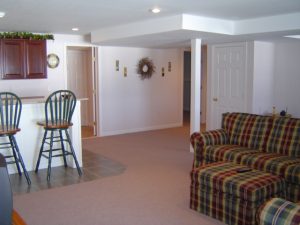
You now have a blank palette ready for a wide range of decorating options:
bedroom, play room, den, family room, game room, bonus room, office, gym,
workshop or bowling alley. The choice is yours! The style is yours! Have
fun!
About the Author - Pamela Cole Harris is an editor and
writer with35 years experience. Visit her website,
http://www.homeandgardenmakeover.com for a
free newsletter with remodeling, home improvement and decorating ideas for
the financially challenged, creatively deficient and technologically
illiterate.
For more help on Finishing
Basements, see HomeAdditionPlus.com's
Basement Remodeling Bid sheet. The
Basement Remodeling Bid Sheet will help
ensure that your hire the right contractor so that your basement remodeling
project is done
correctly and you get the project finished on time and budget.
How to Finance your Basement Remodeling Project -
can help provide funds for your new home improvement project if financing is
required.Related
Basement Remodeling Information
Additional Basement Remodeling Resources
Get Free Basement Remodeling Price Quotes
with
No Obligation!
Fill out our 3-5 minute quick and easy form, and receive a free price quote
on basement remodeling from one of our prescreened and licensed basement
remodeling contractors. This process is free and there is no obligation to
continue once you receive your basement remodeling price estimate.
|
|
|